IB DP Theatre
Solo Theatre Piece
One performer, one theorist, one aspect. The report carries Criteria A and B; the examiner watches the video separately for C.
Robert Lepage, Multimedia
4–7 min solo on mortality, using Lepage's multimedia and live feed. Walk through how each criterion was earned.
Researching theatre theory
Explain why the theory mattered to its theorist. Cite primary sources. The examiner is not interested in their life story: only select key moments from the theorist's life if they directly impact their overarching intentions for their work, your own intentions and the aspect you are going to delve into.
- Open with the theorist's overarching intention in their own words, with a cited primary source, not biography.
- Link biography to theory in one clear sentence: how their lived experience shaped their practice.
- Name 2–3 on stage techniques, each evidenced by a specific named production.
- Close Ai by previewing the aspect you'll focus on in Aii.
Lepage views theatre as a "journey of exploration rather than a fixed art form" (Lin), highlighting an experimental, evolving approach that breaks from tradition.
Growing up bilingual, Lepage "was never held back by the conflict of cultural identity, but set off to explore the world"… This extensive, firsthand engagement with various cultures and languages directly fueled this desire to create theatre that is understood and appreciated by audiences worldwide.
Like in 887, he utilised a rotating doll's house that shifts between Lepage's childhood home and his adult reflections (Soloski), creating an interplay of past and present that "reflects the subjective nature of memory" (Dundjerović).
Chosen aspect of theory
Name one aspect (not two) and define it in the theorist's own terms.
- Open Aii with a one sentence cited definition of your chosen aspect. Be specific ("Verfremdungseffekt", "multimedia") rather than broad ("Brecht's political theatre"). It will be easier to justify later on.
- Tie the aspect to the theorist's overarching intention from Ai.
- Give three concrete on stage uses, each named production + effect produced.
- End Aii stating: this is what I will use, this is the impact I will aim for on my audience.
Multimedia is the integration of diverse digital and non digital elements into live performance (Routledge Performance Archive). Within Lepage's works, this includes the integration of "other art forms into his theatre" (Dundjerović).
In The Far Side of the Moon, a washing machine door becomes a spacecraft hatch, a goldfish bowl, and the moon's surface through changing projections, fluidly altering the audience's perception of space (Delaney).
In Needles and Opium, images of Miles Davis and Jean Cocteau were projected onto the actor's body, transforming him into a canvas for their stories and emotions (Fricker).
Developing the piece
Show how your ideas developed: the initial idea, what was not creating the impact you wanted for the audience, what you changed and how you justify that change through your overarching intention. Not a finished piece description.
- State your final intention in one sentence at the start, so every change has something to be measured against.
- For each major moment, write a three beat paragraph: what you tried, why it was not achieving the impact you wanted for the audience and what you changed to achieve it.
- Tie every change back to the theorist's technique ("sticking to Lepage's idea of…") and justify it through the impact on the audience.
- Close Bi by returning to your overarching intention. It may not have changed: often your ideas have developed so that the same intention lands more clearly for your audience.
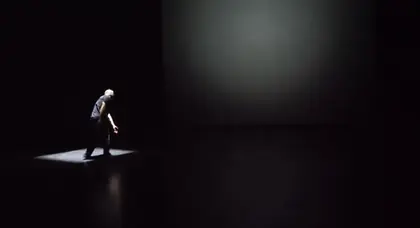
Initially, me just standing up seemed too literal, lacking the metaphorical resonance I aimed for. Recognizing the power of incorporating other art forms to universally communicate to audiences, a key tenet of Lepage's multimedia, I instead decided to perform a dance influenced, upward moving sequence.
Initially, I experimented with projecting an image of the cosmos onto my body… However, this interaction felt passive and static. With the aim of achieving a more immersive effect, then I experimented with a video cosmos projection. As the cosmos moved across my body… it appeared as if my body floated through the infinite.
Sticking to Lepage's idea of object transformation through live feed, I decided to use a scrapbook, a symbol of life and memory, live projecting the pages onto the stage… each page transforming from physical images into a kaleidoscope of personal history and reflections.
Evaluating the piece
Evaluate against your own intention using specific audience response: justify what worked through its impact on the audience. Name failures with reasons.
- Open B2 with a one sentence verdict against your intention. Not "Overall it went well", that's a band-3 sentence.
- For each major moment, quote at least one specific audience response and link it to the intended effect.
- Name at least one failure, what didn't land, why, what you'd change.
- Close with a one sentence overall verdict naming the technique and the effect.
One audience member noted that "watching your life dissipate, somehow made ours do so as well, like we were on a journey together through time," highlighting how "fragile our existence is", turning the personal narrative into a universal message.
There was a choreographing issue which inhibited this as I forgot to touch one of the images, which disrupted meaning as "it felt like a memory was skipped or forgotten."
One audience member commented, "I understood the idea with the clock, but it felt like it ended just as I was starting to really think about it." This suggests that a more extended exploration could have allowed for a deeper engagement with the intended metaphor.
How to structure your Solo Theatre Piece report
A 2,500 word report covering Criteria A and B. The report supports a 4–7 minute video which examiners watch separately for Criterion C. Every word should earn marks, the examiner does not need you to describe what they can already see.
Criterion A · The Theatre Theory & Chosen Aspect
Criterion A is your research foundation. It tests whether you understand your chosen theorist deeply enough to explain BOTH their overarching intentions for theatre AND one specific aspect of their theory. The examiner is not assessing how much you can summarise, they are assessing whether your research is contextual, properly sourced and grounded in actual staging.
1000–1100 words total. Roughly 500 for Ai and 500–600 for Aii. If you are running long, you are probably listing techniques instead of analysing them.
What will stop you getting a 7
- ✕
No overarching intention named
You must name what your theorist wanted theatre to DO, not just biography or techniques.
Maximum 2
- ✕
No primary sources cited
Two well used primary sources beat ten listed in a bibliography you never quote.
Maximum 2
- ✕
Descriptive ideas with no staging evidence
Every claim about the theory needs production evidence, what did it look like on stage?
Ai capped at 2
Overarching Intentions
“With specific references to their research, to what extent does the student explain their chosen theatre theory with a focus on the theorist's overarching intentions?”
→ WHO is this theorist, WHAT did they want theatre to do, and HOW did they realise that vision on stage?
What it is · what it is not- Naming the theorist's overarching intentions for theatre
- Contextualising the theorist in their historical moment
- Showing socio political and cultural influences on their vision
- Identifying who they were building on or rejecting
- Citing specific primary sources (essays, manifestos, books)
- Showing the vision realised through production examples
- A biography of where they were born and everything you know about them
- A list of techniques without the vision behind them
- Vague claims like "Brecht wanted to make people think"
- Wikipedia level summary
- Theatre history with no staging evidence
- Anything about your chosen aspect, save that for Aii
- Open with the overarching intentionOne clear sentence: theatre to [do what] in order to [what end].
- Establish contextBriefly place the theorist in their historical moment. What influences shaped this vision?
- Name what they were rejectingWho or what was the dominant theatre culture they were responding against? Brecht against naturalism. Artaud against theatre that made out life was all rosy. Grotowski against the well made play.
- Cite primary sourcesReference essays, manifestos or books, with date and direct quote where possible.
- Show staging evidenceName a specific production and show HOW the intention manifested in performance. This is what stops Ai being capped at 2.
- Connect backClose by linking the staging choice to the overarching intention.
"Brecht's overarching intention was to politicise theatre, to transform passive spectators into critical thinkers capable of analysing social conditions and acting upon them. Writing from exile during the rise of European fascism, Brecht rejected the emotional immersion of naturalist theatre (the dominant Stanislavskian mode he had encountered through the Moscow Art Theatre's tours) because he believed identification produced political passivity. In 'A Short Organum for the Theatre' (1948), he argued the spectator must be 'placed in front of things' rather than 'thrown into them.' This vision was realised through productions at the Berliner Ensemble such as 'Mother Courage and Her Children' (1949), where placards announcing scene outcomes before they occurred removed suspense and redirected the audience's attention to HOW events unfolded, analysis over investment."
- Names the overarching intention in the first sentence
- Contextualises in the socio political moment (rise of fascism)
- Shows what Brecht was REJECTING (Stanislavskian naturalism)
- Cites a specific primary source ('A Short Organum') with date
- Uses a direct quote from the source
- Names a specific production with date (Mother Courage, 1949)
- Shows the intention REALISED on stage (placards)
- Connects the staging choice back to the overarching intention
- [Theorist]'s overarching intention was to…
- Writing from [context], [theorist] rejected…
- In '[primary source]' ([year]), [theorist] argued…
- [Theorist] developed this vision in response to…
- This intention was realised in [production] ([year]) through…
- The staging choice of… served the overall intention because…
Chosen Aspect
“With specific references to their research, to what extent does the student explain the chosen aspect of their theory?”
→ WHICH specific element of their theory have you chosen, HOW did it work in practice, and WHY did it serve the theorist's overall intentions?
What it is · what it is not- Deep focus on ONE specific aspect of the theory
- How that aspect developed in the theorist's work
- The theorist's own terminology, used precisely
- Direct examples from productions or training
- What the aspect LOOKED LIKE on stage
- Explicit alignment between aspect and overarching intentions
- A list of every technique the theorist used
- The same content recycled from Ai
- Generic theatre vocabulary
- Quoting general textbooks or websites
- Defining the aspect without showing it
- Aspect chosen too broadly to give real depth
- Name your aspect clearlyOne sentence stating exactly what you have chosen and what it means.
- Locate where and when it developedPlace the aspect in the theorist's career, period, productions, collaborators.
- Use the theorist's terminologyTheir specific vocabulary, not generic theatre language. Define where needed.
- Cite primary sourcesDirect quotes from the theorist about this aspect.
- Show it on stageSpecific productions with dates. What did it LOOK like? How was it executed?
- Link to overarching intentionsClose by showing how the aspect served the broader vision from Ai. This is the join that turns Aii from description into analysis.
"My chosen aspect of Grotowski's theory is via negativa, the principle that the actor's training is not the acquisition of skills but the eradication of psychological and physical blocks. Grotowski developed this idea at the Theatre Laboratory in Opole and Wrocław from 1959, abandoning conventional acting technique in favour of plastiques (physical exercises) and corporeal training designed to expose rather than perform. In 'Towards a Poor Theatre' (1968), he writes that via negativa is 'not a collection of skills but an eradication of blocks.' This was demonstrated in productions such as 'Akropolis' (1962): actors wore identical sacking, used minimal scenic elements and performed in states of physical exhaustion that broke through habituated expression. Via negativa served Grotowski's overarching intention of theatre as 'a meeting' between actor and witness, because the actor's blocks were precisely what stood between performer and audience."
- States the chosen aspect in the first sentence
- Locates the development (Theatre Laboratory, Opole and Wrocław, 1959 onwards)
- Uses the theorist's own terminology (plastiques, corporeal training)
- Cites a primary source with direct quote ('Towards a Poor Theatre')
- Names a specific production with date (Akropolis, 1962)
- Describes what it LOOKED LIKE on stage (sacking, exhaustion, minimal scenic elements)
- Explicitly links the aspect back to the overarching intention from Ai
- My chosen aspect of [theorist]'s theory is…
- [Theorist] developed this aspect at [place] from [year]…
- In [primary source], [theorist] describes… as…
- This was demonstrated in [production] ([year]) through…
- On stage, the aspect manifested as…
- This aspect served [theorist]'s overarching intention because…
Criterion B · Reflecting on the Performed Solo Theatre Piece
Criterion B assesses your ability to reflect on your creative journey AND honestly evaluate your final performance. Bi shows HOW you made the piece (process). Bii shows how WELL the piece worked (evaluation with audience feedback as evidence).
Roughly 1300–1500 words across both strands.
What will stop you getting a 7
- ✕
Narrating the video in Bi
If you only describe what the examiner can see in your performance, the maximum mark for Bi is 1 out of 4. The examiner watches your video separately, they do not need you to tell them what happens. They need to know HOW you got there.
Bi maximum 1/4
- ✕
Only discussing successes in Bii
To reach 7–8 in Bii you MUST discuss both what worked AND what did not work. Appraise (5–6) names some strengths and/or limitations. Evaluate (7–8) requires a BALANCE of both, with audience feedback as evidence.
Bii maximum 5–6
Development Process
“With reference to your theatre maker intentions, to what extent do you explain the process of developing the solo theatre piece, as informed by your chosen theory?”
→ How did you CREATE this piece? Show the journey, not just the destination.
What it is · what it is not- Documenting your brainstorming and initial ideas
- Explaining practical experiments you tried
- Showing what you rejected and WHY
- Describing discovery moments in rehearsal
- Connecting decisions to your intentions
- Showing how theory informed your choices
- Narrating what happens in your video
- Describing your final piece only
- Justifying intentions without showing exploration
- Explaining what elements mean to the audience
- Confusing conceptualisation with practical development
- Telling the examiner what they can already see
- State your intention for this elementWhat were you trying to achieve? Connect this to your theatre maker intentions.
- Describe your first attemptWhat did you initially try? Be specific about the practical work.
- Evaluate why it did not workBe honest, what was the problem? "Too literal", "lacked depth", "felt passive".
- Explain your revised decisionWhat did you change? Why was this better? How does it connect to your theorist?
"Inspired by Lepage's use of projections to portray location and interaction, I decided to experiment with projecting the cosmos on my body to immerse me in the grand scale of the universe. Initially I projected a static image of the cosmos, this felt passive. I then experimented with a video cosmos projection. As the cosmos moved across my body, paired with my physicality, it appeared as if my body floated through the infinite."
- Three clear stages: initial decision linked to theorist → honest evaluation that first attempt "felt passive", then the change to video projection
- Explains WHY the new version worked better
- Connects to theorist and intention at every stage
- Does not just describe the final effect, shows the discovery process
- Initially, I experimented with… however, this…
- My first attempt involved… but this felt…
- I then decided to try… because…
- This prompted me to explore…
- The incorporation of [element] achieved…
- Inspired by [theorist]'s use of…, I decided to…
Evaluating the Piece
“With reference to audience feedback, to what extent do you evaluate the effectiveness of the presented solo theatre piece, explaining the extent to which the piece fulfilled its intentions?”
→ How EFFECTIVE was your piece? Use audience responses as evidence for a balanced judgement of strengths AND limitations.
What it is · what it is not- Quoting audience responses directly
- Analysing what the feedback reveals
- Connecting feedback to your intentions
- Using feedback as evidence for claims
- Including critical feedback honestly
- Discussing BOTH successes and limitations
- Vaguely mentioning "audience members said…"
- Listing feedback without analysis
- Only including positive responses
- Making claims without evidence
- Ignoring feedback that criticises your work
- Pretending it all worked perfectly
- State your claim about effectivenessDid this element achieve what you intended? Be direct.
- Quote audience feedback as evidenceUse their exact words. Multiple quotes strengthen your evidence.
- Analyse what the feedback revealsConnect the feedback to your stated intentions. Did they experience what you wanted?
- Acknowledge limitations (for balance)What did not work? Use feedback as evidence. Suggest what could have been different.
"The 'most impactful moment' was at the end, where a projected collage of images representing different stages of my life dissolved into stardust as I touched and let go of them. Several audience members noted it symbolised the 'act of reflection at the moment of death,' allowing them to reflect on how 'quickly life passes.' However, I forgot to touch one of the images, which disrupted meaning as 'it felt like a memory was skipped or forgotten, consequently disrupting the flow of reflection.' The moment when I stood before the projected clock effectively conveyed humanity's subservient relationship with time, but one audience member commented 'I understood the idea with the clock, but it felt like it ended just as I was starting to really think about it.' A more extended exploration could have allowed deeper engagement."
- Quotes specific audience responses (their exact words) and uses them as evidence
- Names the intention each comment relates to
- Acknowledges TWO specific limitations: a performance error and a structural issue
- Uses audience feedback to evidence both successes AND failures
- Suggests what could have been done differently
- This balance of success and limitation is what separates "evaluate" from "appraise"
- Audience members noted that "…" which suggests…
- This effectively achieved my intention because…
- However, one audience member commented "…"
- The feedback reveals that… which indicates…
- A more extended exploration could have…
- While this moment succeeded in…, it also…
The full exemplar
The extracts above are only the highlights. Read whole pieces start to finish and see exactly what a 7 looks like.