IB DP Theatre
Production Proposal
You are the director now. Twelve pages that demonstrate a complete staging of a published play: ideas, intentions, design and one moment, line by line.
1984, Icke & Macmillan (after Orwell)
Modern reframing of 1984 in the landscape of social media and cancel culture. Black box · 3 sided audience · live feed throughout. Walk through theme → intention → design → moment.
Key ideas and themes: straight into the themes, with a personal response
Go straight into the themes. Each theme needs a textual quote with a page reference and your personal response. Only bring in playwright context where the play is an adaptation and that context directly shapes your reading.
- Go straight into the ideas the play addresses. You do not need to tell the examiner everything about the playwright.
- For each theme, pull a quote with page number, then explain what the play argues through it and give your personal response.
- Cover 3+ themes, each grounded in the text and your own reading.
- If the play is an adaptation, like 1984 from Orwell's novel, briefly distinguish the original author's intention from the adapter's intention where it shapes your staging. Otherwise leave the playwright's story out.
"There was no way of knowing whether you were being watched at any given moment" (p.g. 13). As exemplified by the quote, this unknown presence had made civilians fearful, forcing them to fall into submission to the party's wills.
"It's a beautiful thing, the destruction of words." (p.g. 38). The fact that he calls this process 'beautiful' alludes to the idea that it is with the limitation of language that their true desire, total control, is satisfied.
"1984" is a dystopian play script adapted by American playwrights Robert Icke and Duncan Macmillan in 2013 from George Orwell's original novel… Orwell had written the original novel during WWII. During this period, he realised that war propaganda was at its all time peak, being used as a powerful tool to shape public opinion.
While Orwell envisioned a future dominated by blatant authoritarian control, Icke and Macmillan (I&M) wanted to expose a covert type of control emerging. In 2013, when they adapted the play, the US National Security Agency's (NSA) post 9-11 vast network of secret citizen surveillance programs was newly uncovered.
Theatre maker intentions: why this play for an audience now
A clear intention for staging the whole play and why it would interest an audience now. Vague intentions ("think about freedom") cap at 5–6.
- State what you want your production to do and why it would interest an audience now. That might be a modern parallel, but it does not have to be.
- Back every idea up with evidence from the scenes, or textual or line evidence.
- For every choice you make, think about the impact on the audience: what do you want them to think, what do you want them to feel and what do you want them to question?
- State your performance space, configuration, style, each choice serving the intention.
In my production, I want to also focus on the self imposed censorship we are seeing in the rise of cancel culture… My production will explore how 'cancel culture' perpetrated by extremist groups manifests in control, pressuring self censorship through fear, leading to a society devoid of diverse viewpoints and open discourse.
In the play script, no specific setting is described, only suggested: "it could be a library, a records room, it could be in a school…Rooms like this have existed all over the world for years" (p.g. 13). This leaves me the opportunity to set this story in the modern landscape of social media, which is in its own way a digital "records room" which exists both everywhere and nowhere at the same time.
I want Winston's story to serve as a cautionary tale: I want to use multimedia theatre to make the audience reflect on their own behaviours and tendencies. I ultimately want them to realise that if we do not challenge the notion of this self censorship, we will be living in a world dictated by extremists, and are they ready to accept that reality?
The play will be set in a Black Box theatre with the audience on three sides. This configuration will allow for the audience members to watch each other through the entirety of the play, achieving my intention of showing the audience that in the 21st century, through social media, we are constantly watching each other at all times.
Proposed design: every element backs up your intentions
Set, costume, lighting, sound, props, projection: each one has to back up your intentions. Choices that evolve across the play earn more than static ones.
- Choose three, maximum four, main features of your design that you can keep coming back to and that highlight your overarching intentions.
- For each design element, describe state at start AND state at end. Static design ceilings at 5–6.
- For costume, do not overcomplicate it. You have not got long to write, so think of symbolism, colour and specific aspects of the costume that are easy to link back to intention.
- Include a couple of images or technical drawings with captions explaining the symbol. They do not need to cover every design area.
There will be a giant projected handprint which will fill up a majority of the stage floor. At the beginning of the play, the hand will be made up of spirals that include multi coloured words to exemplify how language and self expression, like biometrics, make us unique as individuals… However, over the course of the play, in moments of control exercised by BB, these words are gradually replaced by "CANCELLED" projections. And at the very end of the play, the stamps that once dominated it will disappear, making it a hollow white outline.
In these moments the actors will go behind the scrim with a light being flashed behind them, achieving a silhouette of the two. The black silhouettes are a representation of the perceived anonymity that individuals believe they have when using social media. However, in these moments, there will be a live feed of the actors taken from behind the scrim projected on the perspex screens, shattering this perceived anonymity.
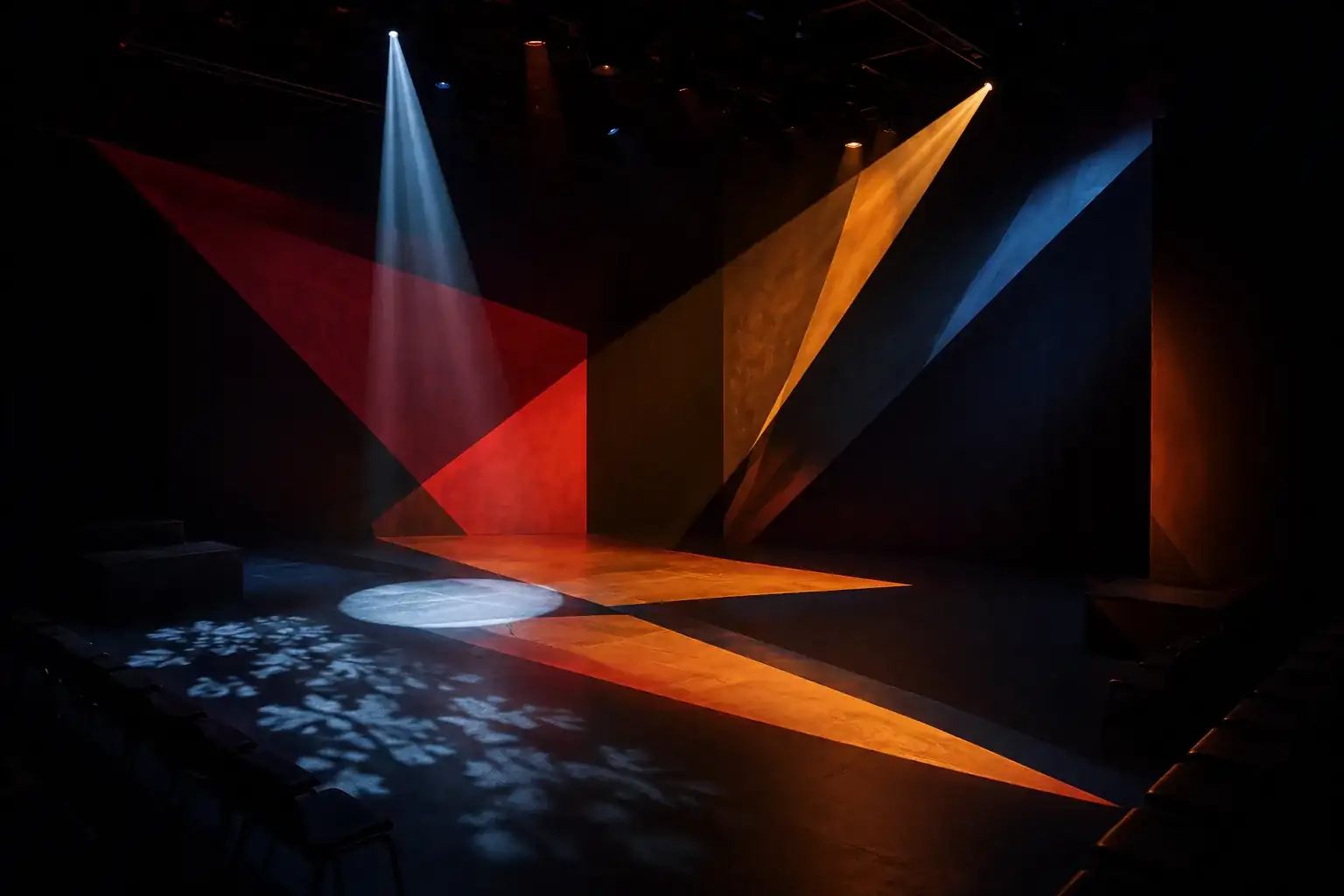
As the play moves forward, there will be a general white flood light that will slowly begin to redden, again symbolising BB's increasing control. While this occurs intensity of the box shutter will also increase, visually amplifying the contrast between the larger society and the others.
Through the course of the play, the costumes will become more covered in red handprints, mirroring the reddening of the hand… The fact that the actors will put the paint on themselves and remove their own accessories symbolises how in the modern context, censorship is self imposed, relating this idea to the new paradigm of cancel culture.
The moment: a single staged page, line by line
A specific page range, worked through line by line: performer action, voice, light, sound, meaning. A tight 2 pages is worth more than a vague half act.
- Open by naming the exact page range and its place in the play's arc.
- Work through the moment line by line (1, 2, 3…) and describe each line as: physicality + voice + light + sound + meaning. Together, not separately.
- For each line, name the audience impact you are engineering. "False hope" earns more than flat tension build.
- Use concrete blocking: levels, distances, body angles, upstage/downstage relationships.
- Close on the final image and silence, not a line. End with a held image + a question for the audience.
As they move towards Winston, after each stop/start motion, symbolising the photo being taken, there will be a strobe flash effect that occurs in parallel emphasising how Winston's pain and suffering are being documented and exploited… With each application of the paint, there will be a "whoosh" delete sound effect, reinforcing the motif of erasure in 21st century cancel culture.
The actor will start talking with a much lower volume and friendlier, high tone and pitch… The sudden shift from relentless torture through extended facial features and large volume to more calm ones could evoke emotions in the audience like a flicker of hope or even relief. Through this performance, the audience will be lulled into a false sense of security… This moment of reduced tension, as a result, only serves to heighten the subsequent tension when Winston doesn't heed his advice and is tortured.
At this moment, both O'Brien and Winston will be centre stage (centre of the palm/hand). Winston will be sat on a desk chair with O'Brien being stood on a box directly behind him holding the phone. The physical position and height exemplifies his dominant position… To further present the meaning, Winston will grab onto the arms of the chair, push his legs straight out and tilt his head up at a forty five degree angle, all while tensing up his arms, body and leg muscles with his widened eyes.
The scene will end with a final, deafening sound effect that echoes throughout the theatre. This will be paired with the strobe lights abruptly cutting out which leaves the audience in complete darkness. Through this silence, the audience is left to ponder the chilling implications… Is Winston a cautionary tale, or are we all subject to the same fate if we do not stand up to surveillance, censorship, and control in the 21st century?
How to structure your Production Proposal
A 12 page proposal documenting how you would stage a published play. Examiners read it as a complete directorial argument: ideas → intentions → design → one moment. Every staging choice must trace back to an intention.
Criterion Ai · Ideas Addressed by the Play
This section asks you to explain the key ideas and themes in your chosen play text, using detailed examples from the script. The examiner wants to see that you genuinely understand what the play is about, not just its plot, but the deeper ideas the playwright is exploring and how those ideas are constructed through the text.
Approximately 2 pages.
What will stop you getting a 7
- ✕
Plot retelling / synopsis
Ai is not a summary of what happens. It is an analysis of what the playwright wants the audience to think about, feel or question.
Likely 2
- ✕
Themes named with no textual reference
Every claim about an idea needs evidence from the text, a quote, a specific moment, a structural choice. The examiner needs to see your ideas come from the play.
Maximum 2
Ideas in the Play
“To what extent does the student explain the ideas addressed by the chosen play text, with reference to the play text?”
→ What does the play want its audience to think about, feel or question, and HOW does the text construct those ideas?
What it is · what it is not- Identifying what the playwright wanted the audience to question
- 3–4 distinct ideas explored in depth
- Specific references to the text (quotes, moments, structural choices)
- Brief context only where it explains an idea
- Explaining the playwright's purpose
- Tracing ideas through multiple characters and events
- A synopsis or plot retelling
- A long historical context essay
- Themes named without textual support
- A list of 5–6 themes covered superficially
- Describing what happens without explaining why
- Generic theme labels (e.g. "the play is about greed")
- Go straight into the ideasYou do not need a paragraph about the playwright's life. Only give context where the play is an adaptation and it explains an idea. Go straight into what the play wants the audience to think about, feel or question, with your personal response.
- Identify 3–4 key ideasGive each its own clearly labelled section. Examples: betrayal, freedom, injustice, power, complicity, corruption, dehumanisation. Frame each as a question if you can.
- Support each idea with specific textual referencesDirect quotes with page numbers, specific moments, scenes or characters, or structural choices (how the plot builds, how acts are organised, repetition, juxtaposition).
- Explain the WHY (not just the WHAT)Describe = what the idea is and where it appears. Explain = why the playwright constructed it this way and what they wanted the audience to understand.
- Use structure as evidenceStrong Ai responses do not only quote dialogue. Explain how the play's structure reinforces ideas, how the plot builds, how repetition or juxtaposition is used.
"This is the first main way justice is interacted with in the play, dealing with the concept in its practical, real world applications. Claire Zachanassian has been able to purchase everything in her life, including justice and both those who dispense it (her butler, the judge) and to whom it is dispensed (her death row manservants). When the Mayor proclaims that 'justice can't be bought' in Act 1 (31), we already know this to be false, as that is what Ill did years before by buying false testimonials 'with a quart of schnapps' (33)."
- Does not simply say "the play explores justice", shows HOW justice is constructed through the text
- Traces the idea through multiple characters: Claire, the butler, the judge, the Mayor, Ill
- Every claim grounded in a specific moment with a page reference
- Uses the Mayor's false claim as dramatic irony, the student is reading the play, not just summarising it
- Explains the idea by tracing it through events, not just naming it
- One key idea explored in the play is…
- This idea is shown when…
- In the moment where [describe], the theme of [idea] is reinforced by…
- The structure of the play emphasises the idea of…
- Through this, [playwright] wanted the audience to recognise that…
- Furthermore, [idea] is not only [X] but also [Y], exemplified by…
- The play asks us to consider whether… / This raises the question of…
Criterion Aii · Theatre Maker Intentions for Staging the Play
Aii is the bridge between the ideas in Ai and the design choices that follow in B and C. The examiner is looking for evidence that you have a clear, specific vision for the play and that every staging decision serves a purpose. This is not a section about what the play is "about", that belongs in Ai. Aii is about what you are doing with it.
Approximately 2 pages.
What will stop you getting a 7
- ✕
Performance space OR style missing
Students who do not include BOTH performance space AND performance style cannot score above the 5–6 band. This is the most common reason students lose marks in Aii. Both are non negotiable.
Maximum 5–6
- ✕
Style described as a genre
Performance style is HOW your actors will work, not WHAT KIND of play it is. Drama, comedy, tragedy are genres. Naturalism, multimedia, physical theatre are styles.
Likely 3–4
Theatre Maker Intentions
“To what extent does the student explain their intentions for the staging of the entire play?”
→ What is YOUR directorial vision? Why this space, this style, these intentions, this audience effect?
What it is · what it is not- A clear statement of YOUR interpretation/take on the play
- 4–6 specific intentions, each targeted and unambiguous
- Performance space (configuration and seating)
- Performance style specified, creative and specific
- Intended audience effect made explicit at every point
- Every staging decision traced back to an intention
- Re describing the ideas from Ai
- A bullet list with vague language ("modern", "interesting")
- Performance space mentioned without explaining the audience stage relationship
- Genre (drama, tragedy) instead of style
- Detailed set/costume/lighting (that belongs in B)
- Generic audience effect language ("the audience will enjoy/think/feel")
- State your interpretationOne or two sentences naming your specific contemporary or conceptual frame. This is your "take", connect it to one or more ideas from Ai.
- List 4–6 specific intentionsEach should name a precise audience experience: realise, shock, expose, sensory overload, cautionary tale. Vague intentions like "make the audience think" will not survive examiner scrutiny.
- Specify the performance spaceBlack box, proscenium, traverse, in the round, thrust, promenade, site specific. Name configuration, audience stage relationship, seating arrangement. Connect each detail to an intention.
- Specify the performance styleNOT a genre. Be creative and specific. Your style can be influenced by a practitioner or tradition, but it does not need to be. You get no marks for mentioning practitioners without a specific example from your own ideas. Explain what your style looks like in practice and why it serves your intentions.
- Make the audience effect explicit at every pointDescribing tells the examiner what your staging IS. Explaining tells them what experience the audience will HAVE, and why your choices produce that experience.
"My directorial approach can be described as a fusion of multimedia and naturalism much like the practitioner Katie Mitchell. I aim to use multimedia theatre to achieve my intention of overwhelming the audience to present the magnitude of cancel culture and self surveillance and their complacency towards it, for example, the use of live audience feeds. Although the setting will be abstract, I want the majority of the acting to be rooted in naturalism to allow the audience to connect with and see themselves within the character. The play will be set in a Black Box theatre with the audience on three sides. This configuration will allow audience members to watch each other throughout the play, achieving my intention of showing that in the 21st century, through social media, we are constantly watching each other. The small size makes self surveillance inescapable for the audience."
- Style is named (multimedia/naturalism fusion) and influenced by a practitioner (Mitchell), with a specific example from her own ideas
- Style split into its two component parts so each can be justified separately
- Multimedia is justified by sensory overload; naturalism by audience identification
- Concrete example given (live audience feeds) so the examiner can picture it
- Three space details (black box, three sided, raked) each explicitly connected to an intention
- Audience watching each other → constant surveillance intention; close proximity → inescapability
- Space ENACTS the play's themes on the audience
- My production will interpret the play through the lens of…
- Reflecting on the ideas of [X] explored in the play, I want to focus on…
- My intentions for this production are as follows…
- I have chosen [space] because it allows the audience to…
- My performance style is [X]. This will achieve my intention of…
- The intended effect on the audience is… / By doing this I want the audience to…
- This decision serves my intention of [X] by…
- Influenced by [practitioner], my production will…
Criterion B · Proposed Design for the Entire Play
This section asks you to present your visual production ideas for the ENTIRE play and to explain how each element will achieve the intentions you set out in Aii. The examiner is checking that you can think across the whole play, not just one striking moment, and that every design choice you make is doing real work.
Approximately 3–4 pages.
What will stop you getting a 7
- ✕
Only describing the chosen moment
If you only describe the design for the moment you are using in Criterion C, you have not fulfilled this criterion. Criterion B = whole play. Criterion C = one moment. Many students unintentionally write a longer version of Cii here, examiners spot this immediately.
Whole play test failed
- ✕
Treating B as a mood board
B is not a design catalogue. Every element must serve a specific intention from Aii. Distribute intentions across elements; do not justify every choice with the same intention.
Likely 2
Proposed Design
“To what extent does the student present their visual production design ideas with an explanation of how these will be used to achieve their intentions in the staging of the entire play?”
→ What does the WHOLE play look and sound like, and how does every design choice achieve a specific intention from Aii?
What it is · what it is not- Visual logic for the whole play (recurring motifs)
- Set, lighting, sound, costume, props, multimedia
- How motifs DEVELOP across the play
- Each element tied to a specific intention from Aii
- Justified exclusions ("minimal props because…")
- Numbered, labelled images referenced in the body text
- A mood board or design catalogue
- Design only for the Cii moment
- A static design state for the whole play
- Generic terms ("atmospheric lighting", "moody soundscape")
- The same intention reused to justify every choice
- Unreferenced images that pad the page count
- Begin with your visual logicBefore listing individual elements, give the examiner a sense of the overall visual world. What are the recurring motifs? What is the dominant aesthetic? Two or three repeated motifs that develop across the play beat ten unconnected design ideas.
- Set, stage architecture and multimediaDescribe the physical structure of your stage. Moving elements, raised platforms, projection surfaces, scrims. Each major element named, briefly described and tied to an intention. Multimedia belongs here unless your style integrates it elsewhere.
- Lighting that develops across the playSpecify fixtures (gobo, fresnel, LED wash, strobe, follow spot, footlights), colour, intensity. A static lighting state can rarely justify itself for a full production, show how lighting transforms to mark changes in tension, emotion, atmosphere or meaning. Try your ideas on the lighting desk on this site: switch channels on, layer directions and colours and see what the state says.
- Sound, the most underused areaUnderscoring, sound effects, ambient sound, silence, music, vocal manipulation. Use sound to anchor mood, mark transitions and reinforce thematic motifs. Sound that contradicts the visual is particularly powerful.
- Costume and makeup as developing motifHow does costume change across the play? Identify costume motifs that develop. Self applied transformations (paint applied by the wearer) carry more weight than applied to costume changes.
- Props, sparingly, justifiedJustify EXCLUSIONS as well as inclusions. One prop fully justified scores higher than ten listed. The strongest responses explain why most props are absent before introducing the few that remain.
"At the beginning of the play, the hand will be made up of spirals that include multi coloured words to exemplify how language and self expression, like biometrics, make us unique as individuals. However, over the course of the play, in moments of control exercised by BB, these words are gradually replaced by 'CANCELLED' projections. And at the very end of the play, the stamps that once dominated it will disappear, making it a hollow white outline. Through the course of the play, the costumes will become more covered in red handprints, mirroring the reddening of the hand. The fact that actors put the paint on themselves and remove their own accessories symbolises how censorship is self imposed in the modern context."
- Names the motif (handprint floor + red paint costume) and tracks it across the WHOLE play
- Three stages: vibrant words → CANCELLED stamps → hollow outline
- Each transformation tied to the intention (individuality → control → erasure)
- Self application of paint = costume becomes staging, carries meaning rather than just identifying characters
- Costume and set motif are interconnected ("mirroring the reddening of the hand")
- Explain level: every detail has a WHY built into the sentence
- To achieve my intention of [X], the [element] will…
- The [element] will be [description], chosen because…
- At the start of the play, [element] will appear as [X]; by the climax, it will have transformed into [Y], reflecting…
- These elements work together to create a coherent visual world by…
- I have deliberately kept [element] minimal so that…
- The intended effect on the audience is… / This will make the audience…
- This continues the motif of [X] established earlier in…
- Drawing on the work of [practitioner], I will…
Criterion Ci · Performance Elements in One Specific Moment
Choose ONE specific moment from the play and explain how you will use PERFORMANCE elements (body, voice, gesture, posture, movement, blocking, manipulation of objects) to create Tension, Emotion, Atmosphere or Meaning (TEAM). This is not Criterion B repeated. B was the overall design of the whole play. C is the precise theatrical detail of one moment.
Approximately 1–2 pages (Cii is the same length, focused on the same moment).
What will stop you getting a 7
- ✕
No numbered annotation on the script
Examiners must be able to read the script and your writing side by side and follow each staging decision in real time. The strongest Ci responses annotate the script numerically (1, 2, 3) and structure their writing around those points.
Likely 3–4
- ✕
Losing clarity between performance and production
You can keep Ci and Cii separate if you want to, or splice them together, moving between performance and production choices as the moment unfolds. What stops you getting a 7 is the examiner not being able to tell which choices are performance (body and voice) and which are production (lighting, sound, set, projections). Keep each choice labelled and clear.
Clarity lost
- ✕
Generic acting language
"Looks scared" or "nervous body language" is not specific enough. Top band requires muscle groups, exact positions, observable detail.
Maximum 5–6
Performance Elements
“To what extent does the student explain how they would use performance elements to effectively create tension, emotion, atmosphere and/or meaning ("TEAM") in one specific moment they have chosen to stage?”
→ For one tightly chosen moment, what does each actor's body and voice do, and which TEAM element does each choice create? Choose the technique, explain how it is used visually, then refer back to the impact it has in communicating your intention for that moment.
What it is · what it is not- ONE specific moment with precise page references
- Numbered annotations on the script
- Physically specific body, posture, face descriptions
- Vocal specifics: volume, pitch, pace, pause, tone
- TEAM element named for each choice
- Ensemble movement as a deliberate physical language
- Generic acting language ("looks scared", "nervous")
- A moment so long it cannot be analysed densely
- Production elements (lighting, sound, set, projection)
- Lists of performance choices without TEAM
- Only addressing the protagonist (ignoring ensemble)
- Repeating what the script already says
- Identify and frame the momentState the page numbers (from X to Y), what happens, briefly why you chose it. Moment should be tight enough to merit close analysis (typically 1–3 pages of script) and rich enough for 1–2 pages of writing across Ci and Cii combined.
- Number your annotationsAnnotate the script with numbered cues (1), (2), (3), then organise your response around those numbers. Examiners should be able to look at script and writing side by side and follow the staging in real time. This is not optional for top band work.
- Body and postureFor each numbered moment, describe what the actor's body looks like with physical specificity. Tense or relaxed? Where exactly are the hands? Angle of the head? Which muscle groups are engaged? Think like a choreographer, every body part has a deliberate position.
- FaceEyes (widened, narrowed, closed), eyebrows (raised, furrowed), mouth (open, clenched, trembling), jaw (tense, slack). The face carries enormous dramatic information, do not waste it on a generic "distressed expression".
- VoiceVolume, pitch, pace, pause, tone, articulation. Do not say "loud", specify the QUALITY of the loudness. Sharp? Booming? Hoarse? Punctuated? Sustained? Vocal contrasts within a moment are particularly powerful.
- Movement, blocking and physical levelsWhere do performers go? Geometry of the space? Object manipulation? Physical levels, stood on a box vs. seated on the floor, carry meaning around power and status.
- Ensemble choreography (where relevant)Stylised, robotic, fluid, fragmented? Synchronised or staggered? Formation? Ensemble movement often carries the strongest thematic load.
"Winston will grab onto the arms of the chair, push his legs straight out and tilt his head up at a forty five degree angle, all while tensing up his arms, body and leg muscles with widened eyes. This tense body language presents the main idea of control and tenses the atmosphere. The actor will present wide eyes, a trembling of the lower lip and furrowed brows to convey the depth of Winston's confusion and fear. O'Brien will project this line at a high volume, punctuated by sharp, staccato outbursts. The actor will then start talking with a much lower volume and friendlier, high tone and pitch. The sudden shift from relentless torture to calm could evoke emotions like a flicker of hope, only serving to heighten the subsequent tension."
- Physical specificity at examiner level: hands on chair arms, legs straight, head at exactly 45 degrees, muscles tensed
- Three precise facial choices (wide eyes, trembling lower lip, furrowed brows), each observable, each part of a coherent emotional picture
- Two contrasting vocal states for the same character within a single moment
- Volume, pitch and rhythm specified for each vocal decision
- The CONTRAST itself is the dramatic engine, student explains how the SHIFT creates emotion (flicker of hope)
- TEAM element named for each choice (atmosphere of control, tension, emotion)
- This is director level direction, fully explained, not just described
- At point (n) on the script, the actor will…
- The actor's body will [specific position], with [muscle group] [tense/relaxed]…
- The actor will present [facial detail], conveying…
- The line will be delivered at [volume], with [pitch/pace/tone]…
- [Performer] will [move/be positioned] at [level], creating…
- This creates [tension/emotion/atmosphere/meaning] by…
- The intended effect on the audience is… / This will provoke…
- The ensemble will [movement vocabulary], symbolising…
Criterion Cii · Production Elements in One Specific Moment
Take the SAME specific moment you used in Ci and explain how you will use PRODUCTION elements (set, props, costume, makeup, lighting, sound, multimedia) to create TEAM. This is not Criterion B repeated. B addressed the design of the WHOLE play. Cii addresses the precise design choices for ONE moment, often with greater depth than B allowed.
Approximately 1–2 pages, the same length as Ci.
What will stop you getting a 7
- ✕
Different numbering from Ci
Cii must use the SAME numbered cues as Ci. Examiners should read your Ci and Cii together as a complete moment by moment direction.
Coherence broken
- ✕
Avoiding overlap with B
Double dipping is ALLOWED and expected. If a production element appeared in B, revisit it here with greater depth. B sets whole play context; Cii drills into how the element functions in this moment.
Likely 3–4
- ✕
Treating production elements as a separate layer
The strongest Cii responses show how production AMPLIFIES performance, how lighting intensifies a vocal decision, how sound punctuates blocking. The moment is a coherent whole.
Likely 5–6
Production Elements
“To what extent does the student explain how they would use production elements to effectively create tension, emotion, atmosphere and/or meaning ("TEAM") in one specific moment they have chosen to stage?”
→ For the SAME moment as Ci, what does each design element (lighting, sound, set, costume, props, multimedia) do, and how does it amplify the performance? You can keep Cii separate from Ci if you want to, or splice them together, weaving production choices between performance choices.
What it is · what it is not- Same numbered cues as Ci
- Lighting fixtures, colours, intensity, angle
- Sound effects, texture, ambient layers, silence
- Set and multimedia functioning within the moment
- Costume / makeup / prop transformations in the moment
- Synthesis with performance choices from Ci
- A static design state for the whole moment
- Repeating Criterion B verbatim
- Generic terms ("atmospheric", "moody", "intense")
- Production addressed in isolation from performance
- Skipping the audience effect
- Treating Cii as shorter or less important than Ci
- Restate the moment and numbered cuesOpen by referencing the same moment as Ci. A single sentence of context is enough. Then run through the SAME numbered cues, addressing production at each point.
- Lighting in the momentSpecify fixtures, colour, intensity, angle. How does it shift in real time? Lighting can transform a moment more drastically than any other production element.
- Sound in the momentSound effects, underscoring, silence, vocal manipulation, ambient layers. Sound moves faster than any other production element, a single cue at the right moment can transform meaning. Punctuate or contradict the visual.
- Set, multimedia and projectionsHow does the set function in this moment? Are projections live or pre recorded? Are screens revealing, concealing, magnifying? Multimedia is most powerful when it manipulates the audience's relationship with what they see on stage.
- Costume, makeup and propsWithin this moment, what is happening with costume / makeup / props? Is something added, removed, transformed? Stage blood, a torn garment, a dropped object, paint applied, each carries dramatic information.
- Synthesis with performanceRead Ci and Cii together. If they could be written about different moments, you have not integrated them. Add a sentence at each numbered cue explaining how the production element interacts with the performance element.
"The photograph will be a phone prop with a flashlight pointing directly down at Winston with the live feed projected onto the scrim as if his phone is recording. This will amplify his distraught facial expressions but simultaneously the tension the audience feel. The red flood lighting will be increasing in intensity and goes into the audience, creating a tense atmosphere throughout the entire venue. As the torturers move towards Winston, after each stop/start motion there will be a strobe flash effect occurring in parallel, emphasising how Winston's pain is being documented and exploited, conveying meaning as it exemplifies how cancel culture often amplifies and commodifies personal pain. With each application of paint there will be a 'whoosh' delete sound effect, reinforcing the motif of erasure. The scene will end with a final, deafening sound effect, paired with the strobe lights abruptly cutting out, leaving the audience in complete darkness."
- Lighting doing two simultaneous jobs: intensifies (tension) and spreads into audience seating (atmosphere extends into venue)
- Each technical choice connected to thematic argument (BB's control / Winston's domination)
- Live feed turns the actor's face into inescapable scenography, audience cannot look away
- Strobe sync with ensemble movement = production and performance work as one unified mechanism
- Recurring "whoosh" motif from earlier in the play pays off in the chosen moment
- Final blackout + deafening sound withholds resolution, audience left in the same state as Winston
- Production design as DRAMATURGY, not just technical work
- At point (n), the [production element] will…
- The lighting will [colour, intensity, fixture, angle]…
- The sound design here is [specific texture/effect], producing…
- The projection / live feed will [action], magnifying…
- At this point, the [costume/prop] will [action], reinforcing…
- This creates [tension/emotion/atmosphere/meaning] by…
- Working in tandem with the actor's [Ci choice], this production element…
- The audience will [specific reaction], because…
The full exemplar
The extracts above are only the highlights. Read whole pieces start to finish and see exactly what a 7 looks like.