Solo Theatre Piece · Robert Wilson
The pages below are the candidate’s actual submitted work, anonymised, rendered exactly as it appeared on assessment. Every paragraph either earns a mark or it does not. Notice what they did, not just what they wrote.
Robert Wilson · Light
A second complete Solo Theatre Piece report, this time on Robert Wilson and his use of light. Same structure, different theorist: read it against the Lepage report and notice what both writers always do.
Ai Wilson’s theatre theory with focus on overarching intentions
Born in 1941 in Waco, Texas, Robert Wilson is an American director known for his "theatre of images" or "theatre of visuals" approaches that give priority to light, movement, immobility, and duration as opposed to linear narrative, dialogue, and psychological naturalism (Holmberg 1996). The general intentions of Wilson on theatre are obvious and conscious: to evade narrative authority and determinate meanings, substitute language with non verbal perception, eliminate emotional manipulation and empathy, and finally to place the audience in a privileged role as co producers of personal meaning out of observation (Shevtsova 1-2; Holmberg 76-98).
A drastic childhood stutter has made him socially isolated, which increased his consciousness of silence, rhythm, gesture and observation as other forms of connection (Shevtsova 48; "Listening to Deafman Glance"). By 17, he was able to overcome the stutter with the help of dance teacher Byrd Hoffman who demonstrated that non verbal expression could speak louder than words (Wilson quoted in "Alain Elkann Interviews"). This self discovery, in opposition to oppressive culture, prompted him to abstraction as a part of rebellion and freedom.
Wilson used John Cage’s silence and duration and Merce Cunningham’s non narrative movement along with his personal addition of surrealism, minimalism, and architecture, making it an influence in New York and the avant garde in the 1960s. He dismissed the Stanislavskian psychology realism (most popular system at the time), in favor of Brechts Verfremdungseffekt in a short term endeavor to distance to provoke critical perception over passive consumption (Holmberg 76-98). Specializing in painting and architecture at Pratt Institute fostered a more spatial and compositional view of theatre. Architect Louis Kahn's lecture "start with light" profoundly influenced his directional choices for staging and performance (Wilson quoted in "Wilson Lights the Lights").
Wilson emerged as a theorist through the creation of the Byrd Hoffman School of Byrds in the late 1960s, which works with non professional and neurodiverse performers. Using the visual communication of deaf and autistic teenager Raymond Andrews who he adopted in 1968 influenced the meaning of his language. His artwork such as Deafman Glance (1970) is almost silent but uses ritualized slow movements interpreted from "Listening to Deafman Glance". The audience’s interpretation of the story was reduced to pure observation, which lead to the creation of personal associations and the prominence of traditional empathy.
This vision is projected on the stage with the help of visual control. In Einstein on the Beach (1976), the opera is five hours long, and it has no plot or characters, instead, the text only consists of numbers, solfège and fragments. The abstract time and space are addressed in motifs like trains, clocks, spaceships and in so called knee plays. Slowness and monotonous movements of the actors in the light become a sculptural figure. Viewers are free to enter and exit and they are detached in their observation, rather then being led to empathize, Wilson allows the audience to interpret things personally ("Einstein on the Beach"; Holmberg). In The Life and Times of Joseph Stalin (1973), "The visual must be so compelling that a deaf man would sit through the performance fascinated," states the importance of visuals in generating autonomous meaning making. This serves by satisfying his desire to have a theatre of perception in which viewers perceive actively by indulging their senses (Shevtsova 48-50).
Aii Explaining the chosen aspect: Light
The main feature of the theory provided by Wilson is light, which is considered as a structural and architectural element, rather than a decoration. It determines space, dispenses chronology, shapes form and directs perception. Something that is precisely desired in intentions to emphasize visuals, avoid the use of language and allow multiple interpretations. According to Wilson, there is no space without light, which connects it to light being the measure of all things proposed by Einstein as well as the influence of Kahn ("Light as an Active Participant"; "Alain Elkann Interviews).
Light on stage is characterized by the intense use of side and back lighting to create sharp silhouettes and shadows through powerful contrast between light and darkness, limited states with slow fades and transitions with emphasis on time. Darkness is used as a structural frame, and it eliminates realism and isolates pictures. Shadows become compositional, bodies are reduced to abstract lines which convey presence or absence (Holmberg 98; "Wilson Lights the Lights").
There was gradual development of light in his initial works. Deafman Glance (1970) puts silent gestures in perspective replicating deaf perception, as the light becomes the supportive, rather than the crucial non verbal instrument. Inspired by minimalism of Cage, visual communication of Andrews and start with light of Kahn, it was later developed by the 1970s to architectural application. Later works made light more structural, defining the space and time before the content, and turned from decorative to an active participant in shaping drama ("Light as an Active Participant").
In Einstein on the Beach, the lighting structures scenes transition to substitute action. The pools enclose performers on bare stages and motionlessness under structural columns compels a long look at duration instead of plot. There is a vertical bar of light serving as a metaphor for time that is repeated three times in the beginning of the play, followed by horizontal light to represent space. It concludes with a horizontal bar gradually becoming a vertical one using controlled fade, but then drifting off and organizing time in an abstract fashion by means of slow duration and change. Strong side and back shots produce silhouettes, darkness frames and eliminates spatial realism, as bodies become forms ("Light as an Active Participant"; "Einstein on the Beach"). This substitutes narrational movement with perceptual experience. Audience experiences time through the holds and fades of light, which creates the sense of relativity through the absence of plot but allows for detached yet active interpretation (Shevtsova 1-2; Holmberg).
Therefore, light follows the intentions of Wilson because it eliminates the use of language, does not allow manipulation by use of distancing, and still requires visual and sensory reading to obtain multiple meanings. Viewers recall images and timings more than plots, noticing differences as eternal, which is significant because it enables the individual to discover rather than be dictated by a story (Holmberg).
Bi Developing the piece
My intention was to depict a process of adapting to a new environment through non verbal adaptation, showing how the body is affected by external spatial conditions rather than internal emotions. My work was directly influenced by Robert Wilson, who abandoned narrative and psychological realism, in favor of visual perception, duration, and the use of light as architecture. I wanted to make the audience active observers, giving them the opportunity to make their own meaning through changes in space and visibility rather than being guided through a fixed narrative. I would have had my piece function upon the same principle: the spectator shall derive their own meaning from what they perceived. Therefore, when starting my planning, I began by asking the question: how does light bring about conditions that the body has to respond to and how does that response amount to adaptation?
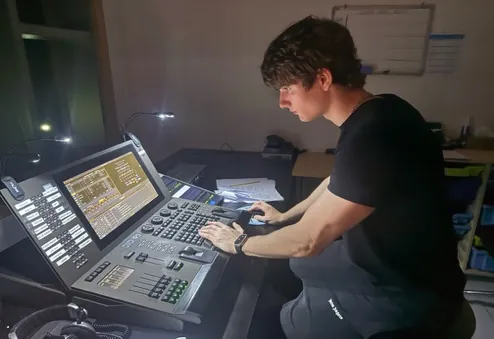
To explore lighting in practice I started by learning the lighting board (Figure 1). I initially thought of brightness and color as the two main variables, changing them would be the most effective way to set the mood or to focus attention on the performer. However, these simple changes only supported my performance instead of shaping the space. This contradicted both my intention and Robert’s Wilson’s approach where light functions as a structural element, forming the space rather than just illuminating the movement.
The transformation was achieved via experimentation. I started Figure 1 to work with direction, shape, intensity, contrast, and tempo. Firstly, I changed the direction of a light instead of its color which completely changed the relationship between the performer and the stage. A performer lit from the side become more of a form than a face; deepening and sharpening the edges as well as a transforming the body from a psychological presence into a visual one. Eight or ten second fades were experienced differently than instant transitions: the fades allowed the audience time to process the spatial change as opposed to merely reacting to it. I also explored the concept of pulsing light and sudden snaps to black transitions. Upon evaluation, I observed that high intensity pulses felt too overt or distracting, while immediate blackouts were resetting my exploration of adaption to a new environment. To improve this I experimented with slower pacing; slowing the pulses down before the transition and extending the blackout durations. Shifting my focus on stronger spatial awareness, and putting more emphasis on duration. These decisions came from Wilson’s theory of time being controlled through light, and audience’s experience of change through duration, not action.
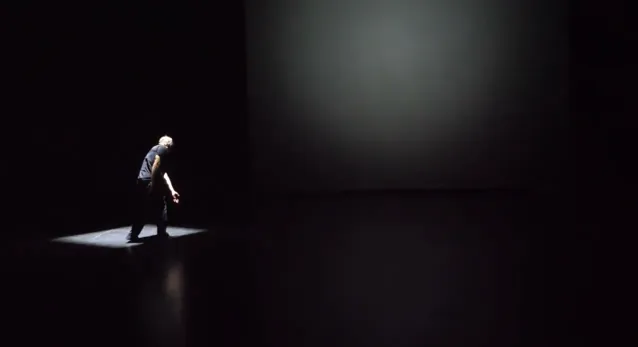
Another significant development within the process came from the replacement of the spotlight with a fixed rectangular area of light. I had used the spotlight to isolate the performer visually, but It felt too passive, following the body rather than imposing any conditions upon it. This was contrary to my intention of exploring the process of adaptation through external spatial pressure because the spotlight allowed the performer to still have control over the space. I therefore decided to experiment with projecting a sharply defined square of light onto the stage that would remain fixed when the I moved within it. As I moved beyond the edges of the lit area, my body parts would be lost to darkness, and as a result, I would be forced to negotiate the spatial restrictions imposed by the light. My movement would not be free but rather be transformed into a visible process of adjustment (Figure 2). When remaining still at the edge of the light, my . . . Figure 2 stillness would no longer appear neutral but would be brought about as a consequence of the spatial condition imposed by the light. As a result of this experiment, I began to grasp Wilson's concept of light as an architectural and structural factor rather than as a decorative element. In this case, the performer was no longer being lit by the light but was adapting to the space created by it.
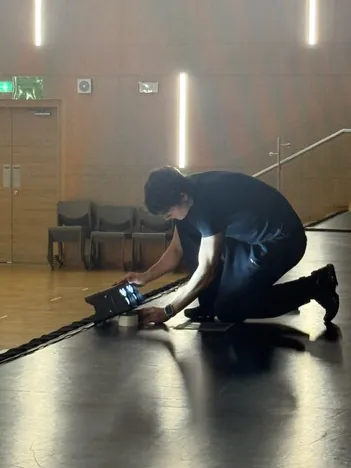
Having established the square, I started to push further. The Initial experiment broke the square light into segmented sections. Although it functioned well as an architectural piece, the light was visually complex and distracting, shifting the audience’s attention to the technical effect rather than the spatial relationship. Because of that, I decided to simplify back to a single unified shape. In the second development, I experimented with light angles, where I used front light against the side light (Figure 3). From this experimentation, I observed that the front light flattens the body, thus reducing the shadow. As a result, I deduced that the Figure 3 side light increases contrast, while elongating the body form. In order to make improvements to these observations, I concluded that side lighting tends to be more effective for defining edges, creating spatial tension, and reinforcing asymmetry. Presenting the body, which is lit on one side, as a form, not a feeling, allowing me to further move away from emotional expression and present myself as a part of the visual composition, closely aligning with Wilson’s use of strong contrast and sculptural lightning to construct spatial perception rather then meaning.
Prior to any refinement, my movements were too expressive and naturalistic, due to the emotional reaction I used as a visible response. This kind of narrative and psychological realism didn’t align with my intention and the idea behind Robert Wilson's visual theatre. To counter that I began to reducing movement altogether and stopped relying on expressive gestures, shifting my focus to stillness and delayed reaction. I only allowed myself to move in response to the change of light. In this way, the body became reactive rather than expressive. As a result, the performer became another element of the visual composition rather than the meaning of the performance. The process of adaptation was embodied in the way the human body adapted to change in spatial conditions through the performance allowing the audience to seek meaning through perception rather than emotional narrative.
Bii Evaluating the piece
I intended to communicate my transition to a new environment through non verbal performance, using light to shape spatial conditions as opposed to narrative or emotional realism. Inspired by Robert Wilson, I sought to position the audience as active observers who construct meaning through perception and spatial change. In the following evaluation, I will consider audience comments and my reflections to assess the success of the piece in meeting my intentions.
The uncertainty I saw from the audience when asking about my performance was the most critical aspect of the audience response. Many said they were not sure what the piece was about when it had just started, but then they began to think about what they were seeing. They described what they were seeing as "it felt like being controlled by something you couldn't control" or "like adjusting to a new space," and "the body looked like it was trying to find where it was allowed to be." Although their ideas were dissimilar in some ways, they were all thinking about restriction, adjustment, and negotiating with space. This suggests the performance successfully communicated adaptation without relying on direct narrative explanation. These comments were exactly what I wanted to hear as it fitted with Wilson's belief that ambiguity is desirable because it causes the audience to actively contribute to the construction of meaning.
In terms of production elements, the square light was the most effective in bringing out the feeling of confinement I desired. One audience member commented that when the body moved outside the light “it felt like it had disappeared.” In other words, the boundary the light created was always present, allowing visibility to become directly linked to the body’s permission to occupy the space. The side light also helped to make the body more abstract, as the audience comments related to the shape of the body and its positioning within the space rather than any emotional expression.
My limited movement and the slow pacing were mostly effective, though not without their drawbacks. The delay between lighting shifts and movement furthered the sense of the body being passively affected by spatial conditions rather than taking autonomous action. Some audience members found the extended stillness difficult to maintain attention toward the performer, particularly during the longer periods of pause. In some instances, the duration disrupted tension rather than maintained it. Nevertheless, the slower pacing was necessary to maintain the perceptual, spatial logic of the work.
Overall, the piece successfully communicated adaptation through spatial and perceptual change rather than narrative or emotion. Light functioned as a structural force that controlled visibility, restriction, and movement, while audience interpretations consistently reflected adjustment and negotiation within the space. Although some pacing lacked precision and occasionally reduced tension, this did not undermine the central logic of the performance, which closely aligned with Robert Wilson’s theatre of visuals.
Works Cited
"Einstein on the Beach." Robert Wilson, robertwilson.com/einstein on the beach.
"Light as an Active Participant in Space: Robert Wilson's Minimalist Approach to Stage Lighting." ArchDaily, 18 Sept. 2024, www.archdaily.com/1021300/light as an active participant in space robert wilsons minimalist approach to stage lighting.
"Listening to Deafman Glance." Robert Wilson Yearbook, Segal Center, thesegalcenter.org/robert wilson yearbook/deafman glance.
"Wilson Lights the Lights." Cooper Hewitt, Smithsonian Design Museum, 29 Apr. 2016, www.cooperhewitt.org/2016/04/29/wilson lights the lights.
Holmberg, Arthur. The Theatre of Robert Wilson. Cambridge UP, 1996.
Robert Wilson. Interview by Alain Elkann. Alain Elkann Interviews, 6 Sept. 2015, www.alainelkanninterviews.com/robert wilson.
Shevtsova, Maria. Robert Wilson. 2nd ed., Routledge, 2020.
Figures from the report