IB DP Theatre
Collaborative Project
A 7 to 10 minute devised ensemble piece. The whole video goes to the examiner and on the cover sheet you select two moments: one highlighting your performance and one highlighting the production element you were in charge of.
A devised performance based upon migrant worker exploitation
Ensemble piece on migrant worker exploitation: carnival motif, cyclical structure, gibberish language. Walk through each criterion, group decisions, changes of idea, individual contributions.
Researching the starting point & ensemble intention
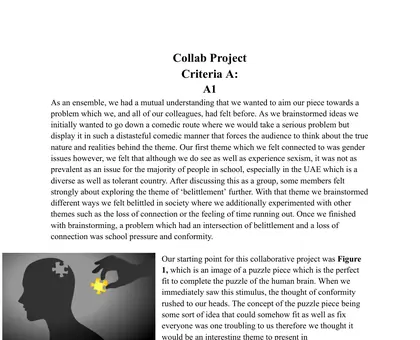
How the group arrived at a shared theme, the starting point, and artistic intention in one clear sentence. Collective reasoning, named changes of idea, a specific named aspect of a practitioner.
- Describe the shortlist of themes, show the group filtering, not arriving fully formed.
- Describe the stimulus in vivid, sensory detail. What did you see?
- Tie stimulus → theme through research and lived observation, not a single sentence.
- Name a specific aspect of a practitioner, evidenced by a specific show.
- State the ensemble intention in one sentence, audience experience + questions to leave with.
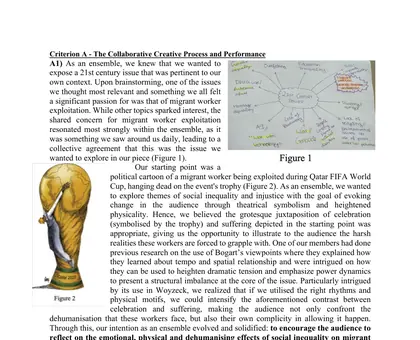
Our starting point was a political cartoon of a migrant worker being exploited during Qatar FIFA World Cup, hanging dead on the event's trophy… we believed the grotesque juxtaposition of celebration (symbolised by the trophy) and suffering depicted in the starting point was appropriate.
Our initial idea was to incorporate multilingual dialogue, with each member speaking their native language… However, when we attempted this within performance, a member had noted that the incorporation of several languages still fell short… Ultimately, we decided to incorporate the use of gibberish language paired with minimal dialogue as we were inspired by Gecko's The Wedding.
One of our members had done previous research on the use of Bogart's viewpoints where they explained how they learned about tempo and spatial relationship and were intrigued on how they can be used to heighten dramatic tension and emphasize power dynamics… Particularly intrigued by its use in Woyzeck, we realized that if we utilised the right rhythms and physical motifs, we could intensify the aforementioned contrast between celebration and suffering.
Our intention as an ensemble evolved and solidified: to encourage the audience to reflect on the emotional, physical and dehumanising effects of social inequality on migrant workers globally while exposing the audience to their own complacency and casual cruelty. We wanted them to ask two main questions: could they do more? And if so, why aren't they?
Evaluating the piece, what worked, what didn't, and why
Evaluate against stated intention with direct audience quotes. Successes and limitations, each tied to a specific staging choice. Ask the audience about your specific element of responsibility so you have responses you can actually write about.
- Open with overall evaluation against intention, backed by an audience quote.
- For each major staging choice (motif, structure, set, sound, physicality), explain intent, then quote audience response. "It worked well" is unmarkable.
- When you gather feedback, ask the audience about your specific element of responsibility as well as the piece as a whole. Their answers give you the evidence you need for Bi and Bii.
- Name at least one limitation per major choice. Honest evaluation, not self promotion.
- Close with a balanced verdict weighing strengths and limitations.
When asked what they thought the circus symbolised, one audience member responded that it felt like "a setting of exploitation, where the audience gains enjoyment and amusement from someone else's suffering." …one audience member sharing how it made them feel "guilty and responsible for the cruelty," as if "we were exploiting them right now, which, in real life, we actually are."
The migrant crawling through the construction structure at the beginning and then crawling back in at the end" served to convey "how they are born into this exploitation" how there is "no escape but death", emulating a "relentless cycle of poverty and exploitation."
Yet, the utilisation of tempo reduced the overall efficacy of these moments… when we asked the audience about the impact of our use of tempo, they commented how it was "not clearly defined" where sometimes the "worker seemed to be moving at the same pace as some of the other characters."
Yet, one audience member noted the set piece to just be 'decorative', indicating a lack of interaction with the set piece, which diminished its ability to convey the fragility and instability of the migrant workers' lived realities.
Performance skills in a chosen moment
One timestamped 1–2 min moment. Concrete physical and vocal decisions, each tied to meaning and audience impact.
- Name the moment with a timestamp range and what each gesture symbolises in your character's arc.
- Describe physicality concretely: body part, level, tempo, tension, resistance on landing.
- For each gesture, name the meaning AND the audience impact created.
- Use direct eye contact as a deliberate, justified choice, a top band move.
- Build to an emotional peak (collapse, vocal absence, surrender). End with a question your body leaves in the audience's head.
At 1:57, when performing the 'carrying a heavy bag' gesture, I mimicked pulling a bag up into my back, initially elevating my upper body, before slumping my posture through rounded shoulders with my torso leaning downwards… Each step was heavy, initiated by an upward push from my legs, followed by an exaggerated downwards motion. As my foot landed, I chose to present a visible resistance in my ankles and knees in lieu of a light placement.
Lastly, I also deliberately chose to not use voice throughout the moment as it is a metaphor for my character's own voicelessness in society, conveying meaning as it further emphasizing their marginalized and disempowered position.
I furrowed my brows, tightened my jaw and extended my facial features… The fact that I am directly looking and locking eyes with the audience at this moment, transforms these emotions into a desperate plea for recognition, forcing the audience to confront my character's suffering firsthand.
At 2:41, as I mimicked the final attempt to lift the heavy bag onto my back, the gesture that has symbolised the relentless burden of my character's existence, I fully collapsed my body, letting it hang limply… makes the audience avidly aware that the only way these workers can escape their life of hardship and grief (as represented by the gestures) is death.
Production skills in a chosen moment
The production element you led on in a timestamped moment: lighting, sound, set, costume, choreography or direction. A change of idea you tried, rejected and replaced. Every choice argues the ensemble's intention.
- Name your role(s), the timestamped moment, and your individual intention (separate from ensemble).
- Show a change of idea in your element: what you tried, why you rejected it and what replaced it.
- Explain the core image or symbol your element creates and what it represents.
- Show your element evolving across the moment. A static choice earns less.
- End each contribution paragraph by linking to the ensemble intention and the impact on the audience.
I initially wanted to make this a two person scene, with one actor representing the worker, and the other representing the family member. However, through my creative exploration during group rehearsals, I found that having two actors created a sense of mutual presence and interaction which was ineffective in presenting and actually contradicted the message I wanted to communicate. The grief and emotional turmoil in this situation stems from absence and longing, not the presence and interaction… So I made the directorial decision to replace the second actor with a coat stand holding a coat.
I had the coat stand begin at the very top of the scaffolding to symbolise the emotional and physical distance that exists between the worker and their family. This elevation visually establishes the family member as distant and unreachable, mirroring the reality of the worker's separation due to exploitation.
I directed this moment and utilised the coat in this manner as I wanted to layer it with dramatic irony. While the audience witnessed what appears to be a comforting embrace, they were simultaneously aware that this closeness is an illusion, that they are hugging a coat, not a person.
My intention as sound designer was to amplify the impact of what the migrant worker has left behind. Over the top of this scene, I layered recorded messages from multiple loved ones in Hindi and multiple other languages… my choice of using multilingual language in the soundscape underscored the global scale of this exploitation, evoking a sense of universal human connection and loss within exploitation while helping to achieve our intention in a universal manner.
How to structure your Collaborative Project report
A project report (max 10 pages / 4,000 words) plus a cover sheet. The examiner reads your report alongside watching your video, but cannot see your devising process, they only see what you tell them. Specific insight beats chronology.
Criterion A · The Collaborative Creative Process and Performance
Criterion A assesses your understanding of how your ensemble created the piece together and how effectively the final performance achieved your collective intentions. It is the half of the report where you write about the group, what you made, why it worked or did not, and what part you played in it.
Roughly half of your overall report, ~2,000 words across Ai and Aii.
What will stop you getting a 7
- ✕
Chronological rehearsal diary
If you list every rehearsal in order without selecting significant moments, your Ai will likely cap around 1 out of 4. Examiners want specific selected moments, not a timeline.
Ai maximum 1
- ✕
Only discussing successes in Aii
Top band Aii REQUIRES balance. If your evaluation only celebrates successes, you cannot reach the top band. You must interrogate what did not work with audience feedback as evidence.
Aii maximum 5–6
- ✕
Losing focus on your own responsibilities
Make sure your specific responsibilities are the focus. Choose moments where your own view of the process is distinctive.
Likely 2
Collaborative Process
“With reference to significant instances from the process, explain how the piece was collaboratively created by the ensemble.”
→ How did your group MAKE this together? Show specific moments where collaboration shaped the piece.
What it is · what it is not- Selecting two or three significant collaborative moments
- Explaining WHY a moment mattered to the piece
- Showing how a decision changed the direction
- Balancing "we" and "I" perspectives
- Linking moments back to ensemble intentions
- Showing tension, disagreement, breakthrough
- A chronological diary of every rehearsal
- Listing what everyone did each week
- Describing rehearsal warm ups
- Losing focus on your specific responsibilities
- Generic praise of "great teamwork"
- Pretending the process was smooth and harmonious
- Set the contextWhere were you in the process? What was the group trying to achieve at this point?
- Describe the moment specificallyName the rehearsal, the decision, the conversation. Be precise, not "around halfway through" but "in the run through after the read through with our peer audience".
- Explain why this matteredWhat problem did it solve, or what new direction did it open? What would the piece have been without this moment?
- Reflect personallyWhat did you contribute, change your mind on, or learn? Where were YOU in this moment?
- Link to intentionsHow did this moment serve the ensemble's overall intention? Be explicit.
"Our ensemble's intention was to make the audience feel the weight of inheriting a damaged planet. Three weeks into devising, we had built a strong opening but the middle section felt didactic, we were telling the audience climate change was bad rather than letting them feel it. In the rehearsal where we tried to cut six minutes from the piece, Maya suggested we strip out all the climate vocabulary and let the audience read meaning through behaviour alone. This shifted the whole piece. I had been resistant because I had written several of the lines we lost, but watching the cut version I could see the audience leaned in more. This moment taught me that collaboration sometimes means losing the work you are most attached to when the ensemble's intention takes priority."
- Specific moment named (the cut rehearsal in week three)
- Identifies the problem (didactic middle section)
- Names the decision (stripping climate vocabulary)
- Shows personal investment and honesty (writer let go of their own lines)
- Links directly to ensemble intention
- Balances "we" and "I", group decision, individual reflection
- Three weeks into devising, we faced…
- A significant moment came when…
- The breakthrough happened when [name] suggested…
- I initially disagreed with this because…
- Watching this change in rehearsal, I realised…
- This moment mattered because it shifted us from… to…
- Our intention to … was directly served by this decision because…
Evaluating the Final Piece
“With reference to audience feedback, evaluate the effectiveness of the final piece as a whole, in relation to how the ensemble's intentions were achieved.”
→ How well did it WORK? Use audience responses as evidence to judge whether your intentions came through.
What it is · what it is not- Using specific audience feedback as evidence
- Discussing BOTH strengths AND limitations
- Linking effectiveness back to specific intentions
- Quoting audience members' exact words
- Acknowledging where the piece fell short
- Reflecting on what could be developed further
- Listing what people said without analysis
- Only including positive comments
- Generic statements like "the audience enjoyed it"
- Vague claims about "audience members felt…"
- Pretending it all worked perfectly
- Apologising or being self flagellating
- Describe feedback gatheringBriefly state how feedback was collected (talkback, written comments, survey) and how many responses you have.
- Pick two or three evaluation pointsFor each, name the ensemble intention it relates to.
- Quote specific audience feedbackUse their exact words. Multiple quotes corroborate your evidence.
- Analyse what the feedback revealsConnect the feedback to your intentions. Did the audience experience what you wanted?
- Include at least ONE limitationUse feedback as evidence. Analyse WHY this section did not work.
- Suggest a specific developmentNot "we could have rehearsed more", name what you would change and why.
"Our intention was to make the audience feel the loneliness of urban isolation through silence and stillness. Audience feedback strongly suggested this worked in the opening sequence: one viewer wrote 'the long pause before anyone moved was almost unbearable, I wanted to look at my phone, which made the point land.' This evidenced that our use of duration achieved our intention because the audience's own discomfort became the proof. However, the same viewer noted the middle ensemble section 'lost the atmosphere because it suddenly felt staged.' Two other audience members made similar comments. On reflection, we had over rehearsed the choreography in this section, and our precision worked against our intention, coordinated movement read as community rather than isolation. A more developed version would loosen this choreography and stagger entrances."
- Specific intention named at the start
- Direct audience quote used as evidence (not decoration)
- Quote chosen because it reveals WHY the moment worked
- Honest about a section that fell short
- Multiple audience members cited, corroborated feedback
- Analyses WHY the failure happened (over rehearsed precision)
- Suggests a specific development for next time
- Audience feedback was gathered through…
- Our intention to … was effectively achieved because…
- One audience member commented "…", which evidences…
- However, several responses suggested…
- This feedback reveals that…
- On reflection, this section did not fully achieve… because…
- A more developed version of this piece would…
Criterion B · Individual Contributions to the Performance
Criterion B is your individual showcase inside a collaborative report. You write about two distinct moments, one where your performance work was strongest (Bi), and one where your creative, design or directorial work most served the ensemble's intentions (Bii). The two moments MUST be different.
Roughly half of your overall report, ~2,000 words across Bi and Bii.
What will stop you getting a 7
- ✕
Same moment for Bi and Bii
If you write about the same moment for both, you cannot demonstrate range. Choose your moments deliberately at the planning stage.
Bii capped
- ✕
Describing the scene instead of YOUR choices
Bi is not "what happens in the scene", it is "what my body and voice specifically did, how, and why." If you find yourself summarising plot, you are off track.
Maximum 1
- ✕
Bii written as a performer (not creator/designer/director)
Bii must be explicitly framed as creative/design/directorial work, not performance work. Identify your role at the start of the section.
Bii flagged
Performance Skills
“Explain how you used your performance skills (body and/or voice) to effectively contribute to one moment of tension, emotion, atmosphere and/or meaning (TEAM).”
→ What did YOUR BODY AND VOICE do in one two minute moment, and how did this create a TEAM effect?
What it is · what it is not- ONE specific two minute moment with timecode
- Detailed analysis of YOUR body and voice
- Identifying which TEAM element you are creating
- Cause and effect (skill → audience effect)
- Technical vocabulary (pitch, pace, pause, stillness, focus)
- Linking choices to ensemble intention
- A summary of the whole scene
- Description of what others did around you
- Listing every performance skill you have
- Vague claims about "strong acting"
- Generic terms like "I performed well"
- Justifying intentions without showing skill
- Identify the momentGive the timecode (matching your cover sheet). One sentence of context, what is happening.
- Name the TEAM elementChoose ONE. State it directly: "The TEAM focus of this moment was tension."
- Walk through physical decisionsIn order. Use technical vocabulary. Explain the audience effect of each choice.
- Walk through vocal decisionsIn order. Use technical vocabulary. Explain the audience effect of each choice.
- Connect cumulative effect to intentionHow did these choices together serve the ensemble's intention?
- Brief reflection (optional)How did this moment stretch you as a performer?
"From 8:40 to 10:30, my character confronts the group after refusing to participate in their performative grief ritual. The TEAM focus of this moment was tension. I used sustained stillness for the first 40 seconds, no gesture, no shift in weight. My pace in the previous scene had been deliberately quick, so this stillness contrasted sharply and signalled a change of energy. My pitch dropped roughly a third lower than my baseline and my pace slowed to around 70 words per minute. I used three extended pauses (each about four seconds) at key beats: after 'you didn't mean it,' after 'none of us did,' and before the final line. These pauses allowed the accusation to land and held the audience in the discomfort. The stillness and slow pace supported our ensemble's intention to make audiences sit with the inadequacy of performative response, rather than letting the moment resolve quickly."
- Specific timecode given at the start
- ONE TEAM element identified clearly (tension)
- Technical vocabulary used throughout (stillness, pace, pitch, pause)
- Cause and effect chain, every choice paired with its effect
- Pauses described with duration AND placement
- Choices contrasted with what came before (quick pace → stillness)
- Linked back to the ensemble's intention
- From [timecode] to [timecode]…
- The TEAM focus of this moment was…
- I used [skill] in order to…
- My pitch dropped/lifted/sustained…
- I held a pause of [X] seconds at…
- This contrasted with my earlier… and created…
- The cumulative effect was…
- This supported our intention to…
Artistic Contribution
“Explain how your individual artistic contribution(s) to the development and/or staging of the piece effectively contributed to fulfilling the ensemble's intentions in one moment (different from Bi).”
→ What did YOU CREATE, DESIGN or DIRECT in a different moment, and how did this serve the group's intentions?
What it is · what it is not- Your specific role as creator, designer or director
- A DIFFERENT moment from Bi
- Specific creative, design or directorial decisions
- Process of development AND staging impact
- Reasoning linked to ensemble intentions
- Evidence that your work shaped the moment
- Vague claims about contributing to the group
- The same moment as Bi
- "I helped with everything"
- Only describing the final design
- Justifying choices without linking to intention
- Generic praise of the ensemble
- State your artistic roleBe specific: "I acted as sound designer" not "I helped with sound."
- Identify the momentGive the timecode. This MUST be different from your Bi moment.
- Show the development processWhat did you try? What did you reject? Why? Show the journey, not just the destination.
- Explain final choicesBe technically specific about what you ended up doing.
- Connect to ensemble intentionBe explicit. Name the intention and show how your choice served it.
- Show impactAudience response, staging effect, contribution to the moment succeeding.
- Brief reflectionWhat did you learn about this production element?
"I acted as sound designer. The moment at 11:20 to 13:00 is where my work most clearly served our ensemble's intention of urban isolation. During development, we had agreed the piece needed a sonic transition from 'outside' to 'inside the head.' My first attempt layered traffic sounds under tinnitus, too literal, the audience read it as a headache. I then built a soundscape using my own voice recorded twenty four times reading the same shopping list, layered at slight pitch and speed variations, with the original traffic underneath fading out across 90 seconds. In staging, this played from four speakers placed close to audience seating rather than the stage. This proximity meant the sound was happening to the audience, not to the performer, which served our intention of making isolation feel like a sensory condition rather than a narrative subject. Audience feedback confirmed the effect: one viewer wrote 'I felt I was inside someone's head before I realised what was happening.' This contribution taught me that sound design is not decoration, it is a structural element that can change the audience's spatial relationship to the work."
- Clearly states the role at the start
- Different moment from a Bi might use
- Shows the development process, failed first attempt then revised
- Specific technical detail (twenty four layered voices, speaker placement)
- Reasoning grounded in ensemble intention
- Evidence of impact through audience quote
- Reflection on what they learned about the production element
- My artistic role was…
- In the moment at [timecode]…
- My first attempt was… however…
- I then developed…
- This choice served our ensemble's intention because…
- The impact of this contribution was…
- An audience member commented…
- This process taught me that…
Not sure what your lighting is saying?
Your report has to justify every staging choice. Build the state first, read what it tells your audience, then argue it. The desk lives on its own page too.
The full exemplar
The extracts above are only the highlights. Read whole pieces start to finish and see exactly what a 7 looks like.